


Indonesia
Indonesian, Sesongot Gayo, Anaerobic Honey
Indonesian, Sesongot Gayo, Anaerobic Honey
Couldn't load pickup availability
Shipping
We ship using Royal Mail 48hr (standard option) and Royal Mail 24hr (express option).
Free 48hr shipping on all orders over £30.
If you live local to us, GU21 or 22 postcode, then we'll deliver it to you ourselves free - just enter your address at checkout & select "free local deliver"
Share


The specs
TASTING NOTES
Raspberry, Cranberry, Lemon, and Tobacco
COUNTRY
Indonesia
REGION
Bebesen, Sumatra
PRODUCER / FARM
Aulia Kahpi
ALTITUDE
1300 — 1600 masl
PROCESS
Anaerobic and Honey / Pulped natural
VARIETAL
Caturra, Tim Tim, and Typica
TYPE
Regular
ROAST
Medium Roast
Product description
A vibrant coffee from Gayo, processed using the anaerobic honey method and roasted medium-light to give loads of character. Expect juicy raspberry and cranberry, bright lemon acidity, and a distinctive tobacco finish that adds depth and complexity.
I have secured 2 half sacks of this coffee, these Indonesian coffees always prove popular so I don’t see it staying around for too long.
About this coffee
Aulia Kahfi has expanded his business by purchasing cherry from neighboring farmers. His lots are consistently delicious.
'Sesongot' is the name for a beautiful caterpillar native to Gayo that is commonly found hanging about in the coffee trees. Aulia chose to name his experimentally and special processed coffees after the creature due to its unique and very special appearance!
In 2019, Aulia Kahfi place 9th in the Sumatra Prestige Cup for his excellent Wet-Hulled lot. We are thrilled to continue purchasing from him.
Aulia cultivates coffee on Rakyat Farm, which he inherited from his family. He has been involved in coffee production since his early teens but has always had a unique interest in specialty coffee. Since specialty coffee was not in high demand in his area during his teenage years, Aulia spent several years mining and selling Vesuvianite, a precious stone often found near volcanoes. He has since returned to coffee production.
Now in his early thirties, Aulia is entrepreneurial and enterprising. Using an old van or his friend’s car, he has expanded his business by purchasing a few bags at a time from neighboring farmers. He collects and processes ripe cherry from farmers in the Lukup Sabun, Pantan Sile and Ratawali neighborhoods. He’s also recently started buying cherry from Gegarang (Jagong Jeget).
Cultivation
Almost all farms on Sumatra are small. On average, farms are between 0.5 to 2.5 hectares. Coffee is usually the primary cash crop for farmers, but most also intercrop their trees alongside vegetables, potatoes and fruit. This intercropped produce will make up a substantial part of the family’s diet for the year.
In addition to growing coffee as a cash crop, many smallholder farmers also work as hired laborers at the nearby tea plantations. Tea is also a huge crop in the area. The bigger tea plantations are often near coffee farms. When the coffee harvest is finished, coffee farmers will go there and pick tea leaves under contracted labor.
There are more and more initiatives by farmers on Sumatra to organize themselves into cooperatives. In the past, farmers did not have much leverage to help themselves get better prices for their cherry or parchment. When they’re in cooperatives, they can share resources, organize training and negotiate better prices.
Harvest & post-harvest
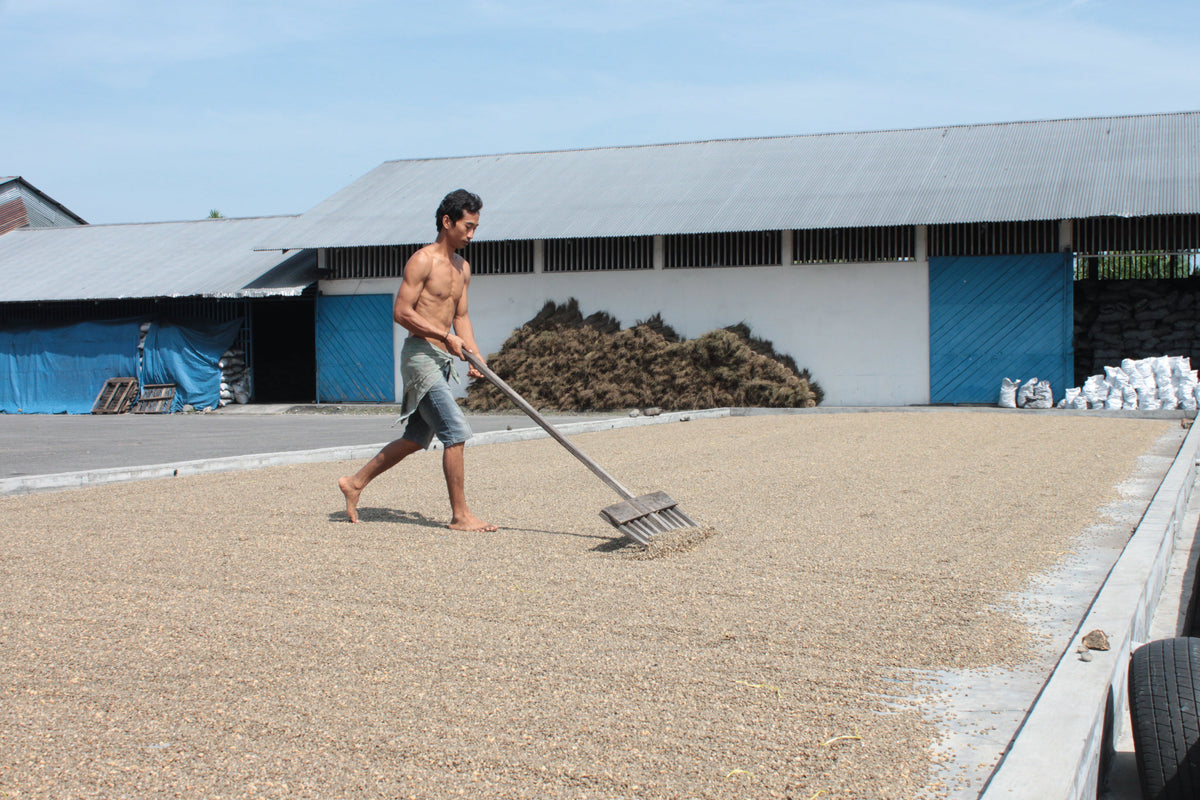
Aulia selectively handpicks ripe, red cherry, or purchases cherry from neighboring farmers. He ferments cherry for 24 hours, changing the water every 12 hours. Following fermentation, Aulia pulps and then strains coffee for about 6 hours before fermenting coffee again for 3 to 7 days. Then, he lays parchment and remaining mucilage on patios to dry. Aulia rakes parchment frequently to ensure even drying. It takes approximately 12 to 25 days for parchment to dry.
Farmers receive fair prices for their cherry and have a fixed buyer for their cherries. The coop’s profit at the end of the year is either invested in infrastructure to improve quality or is shared with the producers. Farmers also receive technical support and seedlings for shade trees for on and around the farm.
Coffee in Indonesia
Indonesia has a long coffee producing history, but recently their coffees have been overlooked by the specialty market. Thanks to our innovative and ever-expanding supply chain, we are proud to bring you high-quality coffees from many of Indonesia’s unique regions, accompanied by in-depth traceability information.
Indonesia is perhaps best known for its unique wet hulling process (giling basah). Though its exact origins are unclear, wet hulling most likely originated in Aceh during the late 1970s.
Wet hulling’s popularity can be attributed to producers’ need for prompt payments. It was also adopted specifically by many producers who lacked the drying infrastructure that was needed to shelter drying parchment from the high humidity and inconsistent rainfall typical in Sumatra. At higher elevations with constant humidity and unpredictable rainfall, drying can prove to be slow, risky and difficult.
FARM/COOP/STATION: Rakyat Farm and about 15 neighboring outgrowers
VARIETAL: Abyssinia, Ateng, Caturra, Gayo, Timtim, Typica
PROCESSING: Anaerobic Honey
ALTITUDE: 1,300 to 1,600 meters above sea level
OWNER: Aulia Kahpi
SUBREGION/TOWN: Gunung Tujuh
REGION: Bebesen, Sumatra
FARM SIZE: 1 hectares on average
HARVEST MONTHS: Sumatra: April-June (main crop) & Nov-Jan; year-round (fly crop)
Information and pictures sourced from Sucafina specialty coffee
How to store coffee at home
To keep your coffee as fresh as possible, you need to protect your coffee from air, sunlight, heat, and moisture. These all will contribute to making it stale and lose flavour.
We suggest keeping your coffee in an airtight container, in a cool, dry cupboard. Our bags all have a de-gassing valve, to let out CO2 that the beans produce once roasted, it's not just there to sniff the coffee, and a reusable ziplock. So if you don't have a fancy coffee jar just push the air out the bag, zip the lock and give the bag another squeeze to get any remaining air out.
Do not store your coffee in the fridge. Roasted coffee absorbs moisture from the air (hygroscopic) and will also take up surrounding aromas. The aromas and moisture levels in the fridge will react with the coffee and delicate flavours will deteriorate.
Choosing Grind Size
If you need some help choosing which grind size to select then checkout which settings we use in the roastery for each brew method, or feel free to give us a shout and ask any questions.