


Kenyan
Kenyan, Handege
Kenyan, Handege
Couldn't load pickup availability
Shipping
We ship using Royal Mail 48hr (standard option) and Royal Mail 24hr (express option).
Free 48hr shipping on all orders over £30.
If you live local to us, GU21 or 22 postcode, then we'll deliver it to you ourselves free - just enter your address at checkout & select "free local deliver"
Share


The specs
TASTING NOTES
Fruit forward, Clean, and Classic Kenyan
COUNTRY
Kenya
REGION
Gatundu, Kiambu
PRODUCER / FARM
Handege Factory
ALTITUDE
1700 — 1800 masl
PROCESS
Washed
VARIETAL
Batian, Ruiru 11, SL28, and SL34
TYPE
Regular
ROAST
Light Roast
Product description
This AB lot from Handege was cultivated and processed with an eye toward excellence. Flavour-wise, expect a signature Kenya profile with excellent clarity and fruit-forward notes. Just the kind of coffee I love at Bell's Beans
I have 2 boxes of this coffee, 60kgs, so get it while you can
About this coffee
Handege factory was constructed in the mid-sixties and started its operations in late 1967. The factory is one of two (the other is Wamuguma) managed by the Ritho Farmers Cooperative Society (FCS), which was registered in 1995 after the split of the giant Gatundu FCS. The name “Handege” is derived from Ndege, the Swahili word for aeroplane or bird.
Today, Ritho FCS works with over 3,000 registered smallholder members, with more than 800 farmers actively delivering cherries to the Handege factory for processing and marketing support. Part of Ritho’s success can be attributed to strong management. In 2010, facing low coffee prices and other challenges, the FCS developed a strategic plan with the primary aim of increasing coffee quality (not necessarily quantity, which is typically the focus in such situations). They also paid close attention to agricultural and organisational management, as well as improving infrastructure. The efforts have resulted in exceptional cup quality of their coffee.
Produced in Kiambu, a region with a rich history of coffee cultivation, this coffee carries the classic profile of Kenyan coffee that we all know and love. This Fully washed lot features a nuanced cup with vibrant fruit notes, complemented by a chocolate-like undertone.
Kiambu is right outside Kenya’s capital city of Nairobi but is nonetheless known for agriculture – specifically coffee and tea. The county is also home of the Kenyan Coffee Research Foundation.
Kiambu County is also well known for its dairy production, and is the largest dairy producing county in Kenya. Many of the growers here adhere to organic fertilizing practices, using only cow manure instead of agrochemicals on their coffee trees.
Farmers in Kiambu face low production due to pests and disease while simultaneously having to pay high prices for inputs. In recent years, many have felt the strain and have sold their land to real-estate developers looking to build on the edge of Nairobi.
Cultivation
The areas around Handege factory typically lie between 1,700 and 1,800 meters above sea level on the slopes of the Aberdare Range. This altitude is critical: it slows the development of the coffee cherry, allowing complex sugars and acids to accumulate that produce the bright, winey citrus-forward flavors that Kiambu coffee is famous for on the international cupping table.
The region experiences a bimodal rainfall pattern. The long rains fall roughly from March to May and the short rains from October to December. Coffee flowers after a dry period followed by rains, meaning Kiambu typically produces one main crop harvested from October through January, with a smaller fly crop possible in mid-year. The temperature range of 15°C to 24°C and the deep, well-drained, humus-rich red clay soils (classified as nitisols) provide excellent natural conditions, but the farmer's input and agricultural practices are crucial to ensure that this potential is achieved.
Kiambu County is also well known as the largest dairy-producing county in Kenya. Many coffee growers in the region are adhering to organic fertilizing practices, using only cow manure instead of agrochemicals on their coffee trees.
Harvest & post-harvest
Processing at Handege factory adheres to stringent quality-driven methods. Smallholders selectively handpick ripe cherries and deliver them to the factory for processing on the same day. At intake, cherries are carefully sorted. This sorting process is monitored by the “Cherry Clerk,” who ensures only the ripest and densest cherries are selected.
After sorting, cherries are then pulped and fermented for approximately 12 to 16 hours, depending on the weather. The parchment is then washed with clean water to completely remove remaining mucilage before drying. Water used in these stages is sourced from the nearby Thiririka River.
At the drying stage, parchment is evenly laid on raised beds or in solar driers (covered greenhouses). The parchment is turned frequently during this stage to ensure even drying. Additionally, workers cover drying parchment during the hottest time of day to maintain slow, even drying and at night to shelter parchments from moisture. It takes approximately 7 to 15 days to complete the drying process.
About SL28 & SL34
SL28 and SL34 were two of the cultivars released by Scott Agricultural Laboratories (SAL) during the height of SAL’s research in Kenya in the 1930s and 1940s. They soon became the cultivars of choice for most growers thanks to their deep root structure that allows them to maximize scarce water resources and flourish even without irrigation. SL varieties also had higher yields than the French Bourbon rootstock that they replaced and were known to be somewhat more disease resistant.
About Ruiru 11
Ruiru 11, a hybrid of Catimor and SL cultivars, is both Coffee Berry Disease (CBD) and Coffee Leaf Rust (CLR) resistant. Plus, it can be planted at a much higher density than the SL varieties, making optimal use of small plots of land.
Ruiru 11 has slowly ‘taken root’ across most of Kenya’s coffee growing landscape. The only issues were that with a shallower root structure, many farmers found the plant less hardy in drought conditions, and the trees required a more intense feeding program. Over time, farmers have found that by grafting Ruiru-11 to SL varieties they could take advantage of SL trees’ expansive root system and still reap the increased yields and higher immunity to disease of Ruiru-11.
Due to the grafted Ruiru-11’s growing popularity, most farms in Kenya today, both big and small, have a mixture of Ruiru-11 and SL varieties. As SL trees age, many farmers are opting to turn more towards Ruiru-11 (or the grafting solution) thanks to its ease of use and higher resistance to diseases.
About Batian
Developed by Kenya's Coffee Research Institute in 2010, Batian is named after the highest peak on Mt. Kenya and is resistant to both coffee berry disease (CBD) and coffee leaf rust (CLR). The variety has the added benefit of early maturity – cropping after only two years. Some challenges (such as vegetative structure) have prevented it from becoming widespread so far, but its popularity is certainly growing.
Coffee in Kenya
Though coffee growing had a relatively late start in Kenya, the industry has gained and maintained a impressive reputation. Since the start of production, Kenyan coffee has been recognized for its high-quality, meticulous preparation and exquisite flavors. Our in-country sister company, Sucafina Kenya, works with farmers across the country to ensure these exceptional coffees gain the accolades they deserve.
Today, more than 600,000 smallholders farming fewer than 5 acres compose 99% of the coffee farming population of Kenya. Their farms cover more than 75% of total coffee growing land and produce nearly 70% of the country’s coffee. These farmers are organized into hundreds of Farmer Cooperative Societies (FCS), all of which operate at least one factory. The remainder of annual production is grown and processed by small, medium and large land estates. Most of the larger estates have their own washing stations.
Most Kenyan coffees are fully washed and dried on raised beds. The country still upholds its reputation for high quality and attention to detail at its many washing stations. The best factories employ stringent sorting practices at cherry intake, and many of them have had the same management staff in place for years.
FARM/COOP/STATION: Handege Factory
VARIETAL: Batian, Ruiru 11, SL28, SL34
PROCESSING: Washed
ALTITUDE: 1,700 to 1,800 meters above sea level
OWNER: 800+ smallholder farmers delivering to Handege Factory
SUBREGION/TOWN: Gatundu
REGION: Kiambu
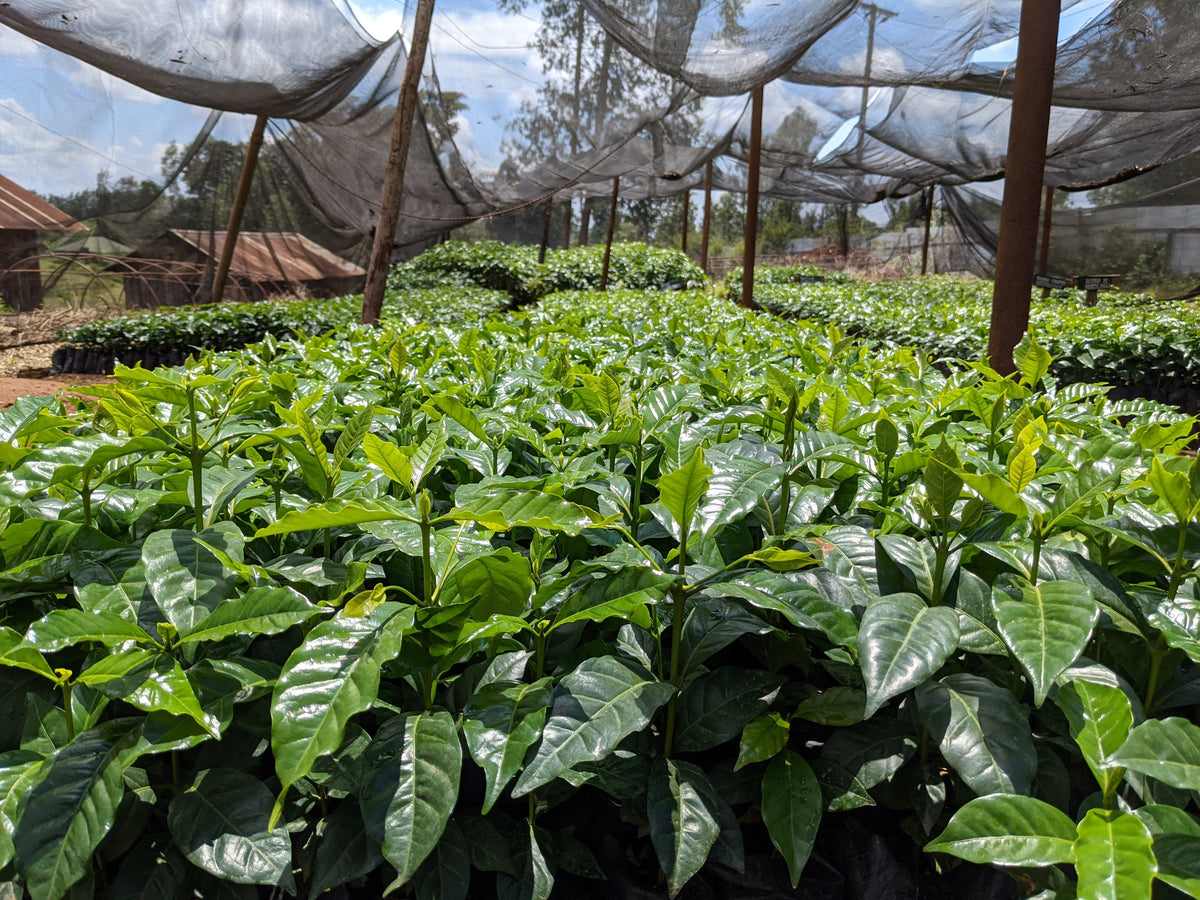
Information and pictures sourced from Sucafina specialty coffee
How to store coffee at home
To keep your coffee as fresh as possible, you need to protect your coffee from air, sunlight, heat, and moisture. These all will contribute to making it stale and lose flavour.
We suggest keeping your coffee in an airtight container, in a cool, dry cupboard. Our bags all have a de-gassing valve, to let out CO2 that the beans produce once roasted, it's not just there to sniff the coffee, and a reusable ziplock. So if you don't have a fancy coffee jar just push the air out the bag, zip the lock and give the bag another squeeze to get any remaining air out.
Do not store your coffee in the fridge. Roasted coffee absorbs moisture from the air (hygroscopic) and will also take up surrounding aromas. The aromas and moisture levels in the fridge will react with the coffee and delicate flavours will deteriorate.
Choosing Grind Size
If you need some help choosing which grind size to select then checkout which settings we use in the roastery for each brew method, or feel free to give us a shout and ask any questions.