
Description
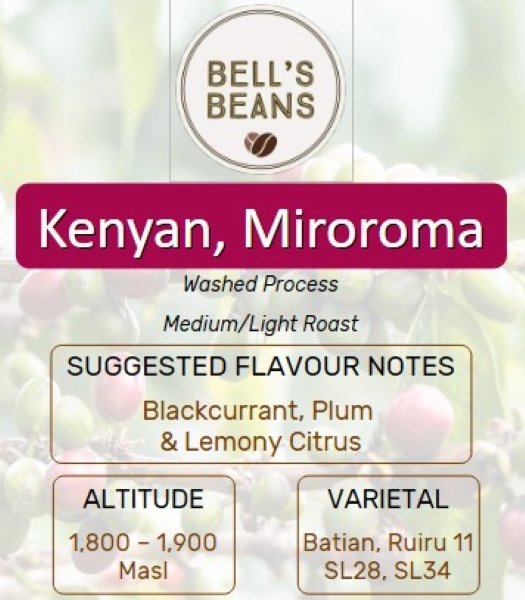
Kenya Miroroma Murang’a AB
This vibrant, juicy AB lot comes from the Miroroma Factory, nestled high in the hills of Murang’a County, one of Kenya’s most renowned coffee regions. Meticulous processing safeguards the exceptional quality born from rich volcanic soils and the dedicated care of contributing farmers
About This Coffee
This Fully washed AB lot from Miroroma Factory exemplifies what we love about coffees from the country’s Central Region. Stone fruit, berries and bright citrus notes abound!
Miroroma Factory is one of two factories managed by the Kanyenya-ini Farmers Cooperative Society (FCS) (the other is Githiga). The cooperative was registered in 1997 and has gone from strength to strength. Today they have a total membership of 2,000 farmers, with about 950 delivering cherry to Miroroma Factory.
COFFEE GRADE: AB
FARM/COOP/STATION: Miroroma Factory
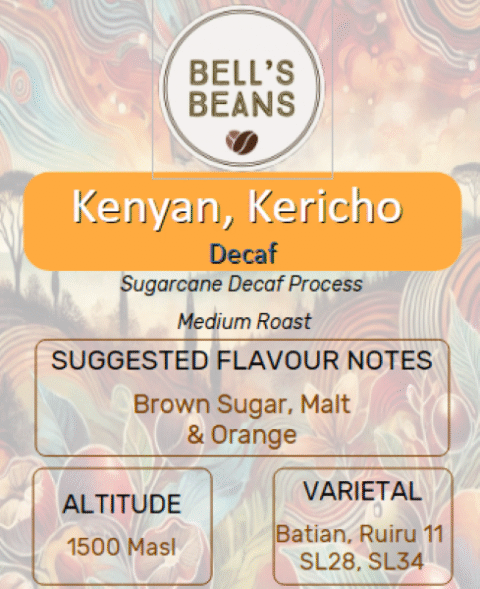
VARIETAL: Batian, Ruiru 11, SL28, SL34
PROCESSING: Fully washed
ALTITUDE: 1,800 – 1,900 meters above sea level
OWNER: 950 farmers delivering to Miroroma Factory
REGION: Murang’a County, Central Region
BAG SIZE: 30kg VacPack
HARVEST MONTHS: Central Kenya: May – July (early crop) | October – December (late crop)
Cultivation
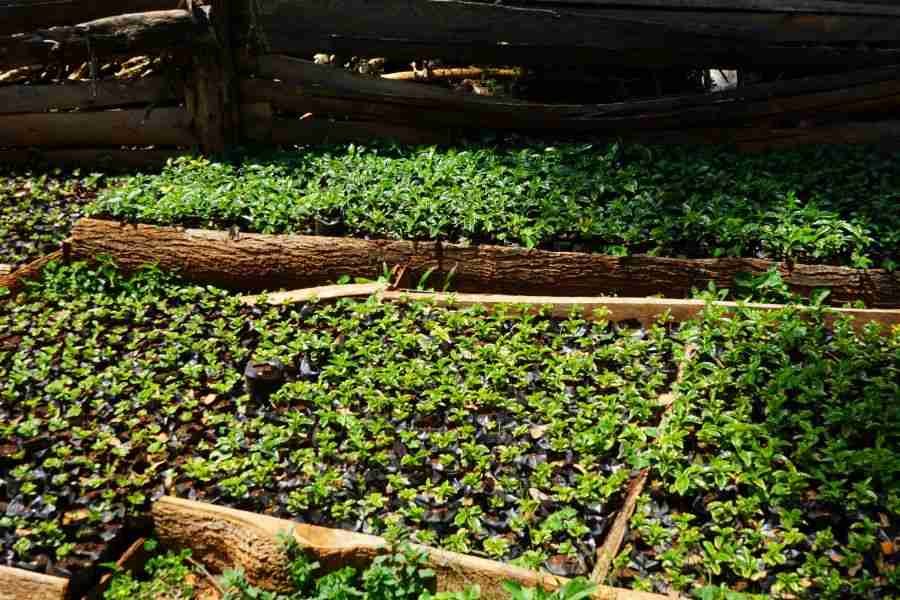
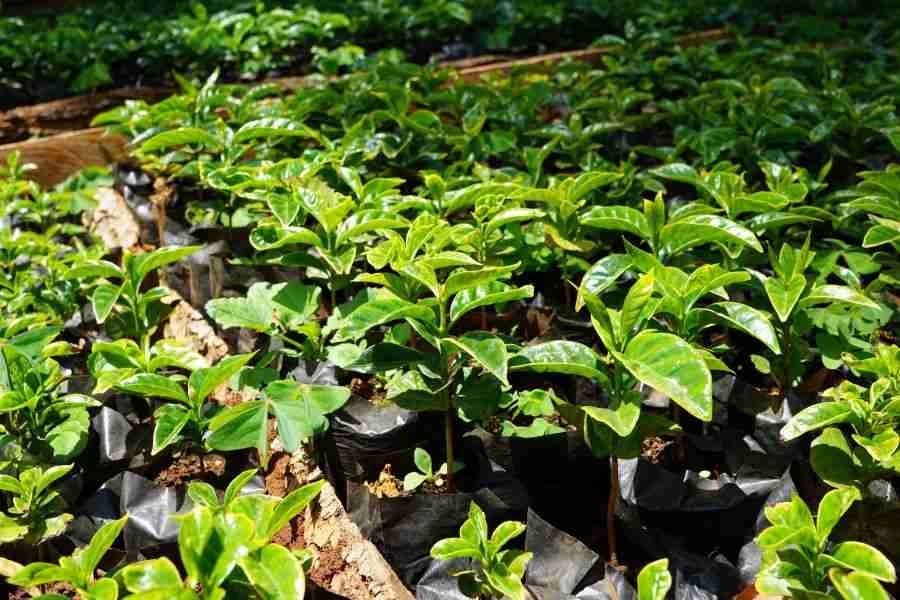
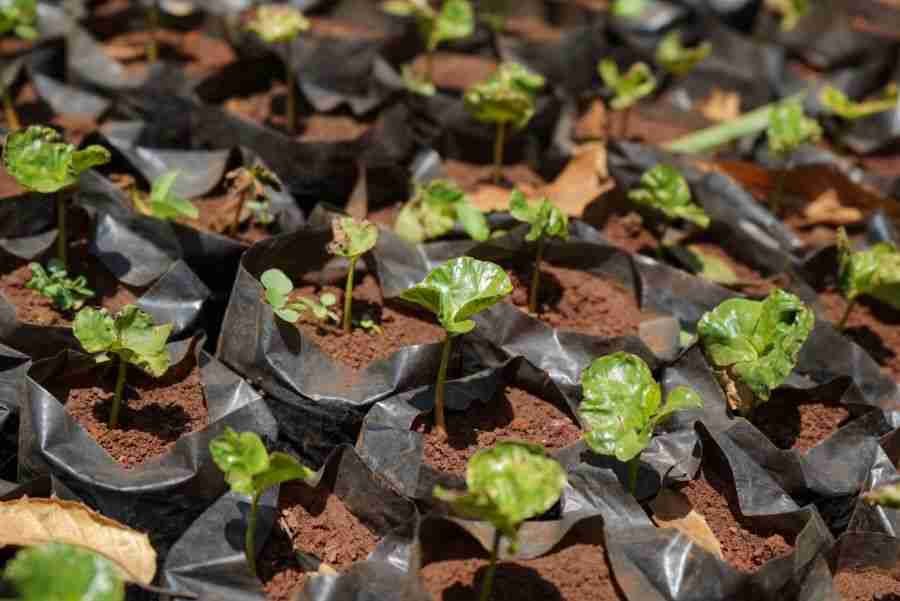
Kanyenya-ini works closely with farmers to maintain high agricultural standards. Farmers in the region cultivate SL28, SL34, Ruiru 11 and Batian at altitudes ranging from 1,800 to 1,900 meters above sea level. Coffee plots are small, usually averaging around 200 coffee trees interspersed with other food crops on small farms called ‘shambas’.
‘SL’ varieties are cultivars originally released by Scott Agricultural Laboratories (SAL) in the 1930s and 1940s. They soon became the go-to trees for many growers in Kenya due to their deep root structure, which allows them to maximize scarce water resources and flourish even without irrigation. Ruiru 11 is a newer variety known for its disease resistance and high yields. It starts yielding fruit after just 2 years.
Harvest & Post Harvest
Ripe cherries are selectively handpicked and delivered to Miroroma Factory. After sorting, cherries are pulped and fermented for 12 to 36 hours, depending on the temperature. The parchment is then washed through grading channels using clean water before being soaked in clean, circulating water for around 24 hours. This measure helps to manage drying bed availability at the peak of the harvest season while also having additional benefits for quality and longevity for the coffee itself. After soaking, parchment is delivered to dry on raised beds, where it will be turned regularly and covered during the hottest part of the day and evenings to ensure even drying. Normal drying time is 14 to 21 days, depending on the weather.
About SL28 & SL34
SL28 and SL34 were two of the cultivars released by Scott Agricultural Laboratories (SAL) during the height of SAL’s research in Kenya in the 1930s and 1940s. They soon became the cultivars of choice for most growers thanks to their deep root structure that allows them to maximize scarce water resources and flourish even without irrigation. SL varieties also had higher yields than the French Bourbon rootstock that they replaced and were known to be somewhat more disease resistant.
About Ruiru 11
Ruiru 11, a hybrid of Catimor and SL cultivars, is both Coffee Berry Disease (CBD) and Coffee Leaf Rust (CLR) resistant. Plus, it can be planted at a much higher density than the SL varieties, making optimal use of small plots of land.
Ruiru 11 has slowly ‘taken root’ across most of Kenya’s coffee growing landscape. The only issues were that with a shallower root structure, many farmers found the plant less hardy in drought conditions, and the trees required a more intense feeding program. Over time, farmers have found that by grafting Ruiru-11 to SL varieties they could take advantage of SL trees’ expansive root system and still reap the increased yields and higher immunity to disease of Ruiru-11.
Due to the grafted Ruiru-11’s growing popularity, most farms in Kenya today, both big and small, have a mixture of Ruiru-11 and SL varieties. As SL trees age, many farmers are opting to turn more towards Ruiru-11 (or the grafting solution) thanks to its ease of use and higher resistance to diseases.
Batian
Batian is named after the highest peak on Mt. Kenya and is resistant to both coffee berry disease (CBD) and coffee leaf rust (CLR). The variety has the added benefit of early maturity – cropping after only two years. Some challenges (such as vegetative structure) have prevented it from becoming widespread so far, but its popularity is certainly growing.
AB Grade
Kenyan coffees are classified by size. AB beans are those that are between screen size 15 and 18 meaning that beans are between 6 and 7 millimeters in size.
Coffee in Kenya
Though coffee growing had a relatively late start in Kenya, the industry has gained and maintained a impressive reputation. Since the start of production, Kenyan coffee has been recognized for its high-quality, meticulous preparation and exquisite flavors. Our in-country sister company, Sucafina Kenya, works with farmers across the country to ensure these exceptional coffees gain the accolades they deserve.
Today, more than 600,000 smallholders farming fewer than 5 acres compose 99% of the coffee farming population of Kenya. Their farms cover more than 75% of total coffee growing land and produce nearly 70% of the country’s coffee. These farmers are organized into hundreds of Farmer Cooperative Societies (FCS), all of which operate at least one factory. The remainder of annual production is grown and processed by small, medium and large land estates. Most of the larger estates have their own washing stations.
Most Kenyan coffees are fully washed and dried on raised beds. The country still upholds its reputation for high quality and attention to detail at its many washing stations. The best factories employ stringent sorting practices at cherry intake, and many of them have had the same management staff in place for years.
Information and pictures supplied by Sucafina
How to store coffee at home
To keep your coffee as fresh as possible, you need to protect your coffee from air, sunlight, heat, and moisture. These all will contribute to making it stale and lose flavour.
We suggest keeping your coffee in an airtight container, in a cool, dry cupboard. Our bags all have a de-gassing valve, to let out CO2 that the beans produce once roasted, it’s not just there to sniff the coffee, and a reusable ziplock. So if you don’t have a fancy coffee jar just push the air out the bag, zip the lock and give the bag another squeeze to get any remaining air out.
Do not store your coffee in the fridge. Roasted coffee absorbs moisture from the air (hygroscopic) and will also take up surrounding aromas. The aromas and moisture levels in the fridge will react with the coffee and delicate flavours will deteriorate.
Need help on which grind size? Click here
News Letter
Fancy 15% off a coffee order? Then sign up to our news letter for a discount code, along with being the first to know about new coffees, special offers, tips and tricks.
Want to know more about Bell’s Beans?

Reviews
There are no reviews yet.